
By Allium Research
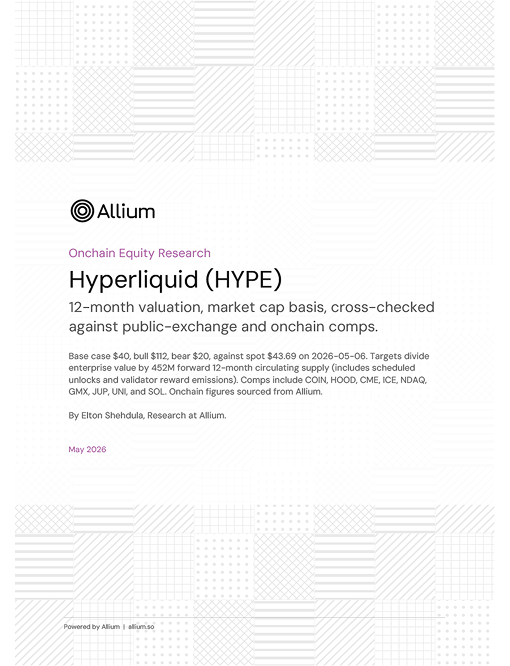
Hyperliquid (HYPE): Onchain Equity Research
12-Month Valuation, Onchain and Public-Market Comps (May 2026)
Hyperliquid runs 70% of all onchain perpetual futures volume, hosts the largest live token buyback program in crypto, and is layering tokenized equity perps and prediction markets on top of a perp engine doing $6.34B in average daily volume. This report builds a full valuation from the ground up: onchain data sourced directly from Allium, public-market comps from COIN to CME, and a two-method blend producing a $40 base, $112 bull, and $20 bear 12-month target.
The core questions this report answers:
- What does Hyperliquid actually earn, and how durable is that fee stream?
- How does the $825M cumulative buyback program affect per-token value at scale?
- What multiple does HYPE deserve relative to COIN, HOOD, and CME?
- How does 39% scheduled supply dilution change the target math?
- Where do HIP3 (equity perps) and HIP4 (prediction markets) fit in the bull case?
For hedge funds, trading desks, and institutional allocators evaluating HYPE as a long-duration position in onchain financial infrastructure.
By Elton Shehdula, Research Lead @Allium
What's inside:
- Tear sheet and recommendation – OVERWEIGHT rating with a $53 probability-weighted 12-month target. Base $40, bull $112, bear $20, against spot $43.69 on May 6, 2026. All targets divide enterprise value by 452M forward 12-month circulating supply.
- Platform snapshot – $14.6B market cap, $6.34B average daily volume, $609M annualized fees at 24x EV/Fees. Product breakdown across native perps (64% of volume, 78% of fees), HIP3 equity and commodity perps (34%), HIP4 prediction markets, and spot trading.
- The buyback engine – $42.5M deployed in the last 30 days. $825M cumulative since March 2025 across 432 days. How the Assistance Fund operates, why 3.5% buyback yield compares favorably to the S&P 500 average, and what happens to per-token value as the price rises.
- Supply schedule and dilution – 333.9M circulating today. 452M forward 12-month supply after 119M Core Contributor unlocks and 9.7M validator emissions, less ~11M AF retirement. Why the honest forward share count changes the per-token target math by 35% versus headline circulating supply.
- Competitive landscape – Hyperliquid holds ~70% of all onchain perp volume. Analysis of three durable moats: HLP (protocol-owned liquidity embedded in the L1), builder codes ($40M+ earned by third-party frontends), and captive USDC balance design. Full perp DEX competitor map.
- HIP3 and HIP4 product optionality – HIP3 equity and commodity perps doing $2.13B average daily volume. Hour-bucketing shows 60% of HIP3 volume occurs outside US market hours. HIP4 prediction markets at <$0.005M daily fees today with base case $10M and bull case $55M annual fee sizing modeled.
- Valuation: two methods, one blend – Method A: two-stage buyback DCF at 22% discount rate, Y1 to Y5 plus terminal. Method B: comparables against COIN, HOOD, CME, ICE, NDAQ, GMX, JUP, UNI, and SOL at EV/Fees. A 30/70 blend of DCF and comps produces final per-token targets across all three scenarios.
- Risk factors and cheat sheet – Eight named risks: HLP concentration, regulatory action on tokenized equity derivatives, stablecoin event risk, hawkish Fed surprise, bear steepener, BTC dominance rotation, competitor innovation, and 39% scheduled dilution. Full scenario table for rapid reference.
Other reports

Prediction Markets: A New Financial Primitive
April 2026
Prediction markets behave less like crowd intelligence systems and more like thin, participant-driven markets where a small number of actors set prices. 65% of all notional volume is generated by just 1% of wallets.
Franklin Templeton on Stellar: Onchain Analysis
April 2026
Five Years of Onchain Evidence from the First U.S.-Registered Money Market Fund on a Public Blockchain In April 2021, Franklin Templeton launched BENJI on Stellar, making it the first U.S.-registered money market fund to operate on a public blockchain. Five years later, BENJI sits at $1.98B across nine chains, with Stellar still anchoring 95% of its holders.
Stablecoins: The emergence of a new payment rail
February 2026
Payments, Geography, Liquidity, and Blockchain Infrastructure (2024–2026) Stablecoins are no longer just trading collateral — they're becoming payment infrastructure. This report analyzes $300B+ in labeled payment volume across 150+ blockchains to answer the questions that matter: Who's paying whom? Where is adoption actually happening? And which use cases are growing fastest?